
Blog
Value Proposition: The Missing Piece of Your Brand Strategy
One of the questions I get asked most often about brand building and marketing is: “What should a brand strategy actually include?” The answer, of course, is “it depends” – a strategy is like a map showing you how to get from point A to point B. What that map looks like depends heavily on where you are today and where you want to end up.
That said, there are a few non-negotiables every strategy should include — a SWOT analysis, positioning, mapping your competitive advantages… Today I'll walk you through one of those non-negotiables: the value proposition.
What is a value proposition?

Daniel Kahneman, the behavioral-economics guru and Nobel laureate, once asked students (most social experiments start with students) how much they'd pay for a two-week stay at their dream resort. The answers matched market reality — students named amounts close to what they'd expect to pay at a travel agency.
Then Kahneman added a twist. How much would you pay for the same trip if, right after you got back, you received an injection that wiped out all your memories of the trip? No other side effects — you'd keep the tan, but you wouldn't have a single memory of the vacation. What would it be worth to you then?
The perceived value of the exact same trip dropped. For many students it dropped to zero — they said they wouldn't even want that product.
A value proposition isn't about what you sell. In both scenarios the travel agency does the exact same job. They entice you with beautifully designed ads. They have great customer service. The flight crew is friendly and the hotel staff caters to your every whim.
In the second scenario, you don't bring home any memories. The value drops to almost nothing. Which means a huge part of your value proposition should be built on memories, not service. And that's exactly the point — asking what a customer is actually willing to pay for, and what you can safely drop.
The concept itself was first named in 1998 by Michael Lanning and Edward Michaels in a McKinsey report titled A Business Is a Value Delivery System. They argued that customers don't buy products or services — they buy the value those things deliver.
It sounds simple, but building an actual value proposition takes a few rounds of analysis. Before we get there, though, there's one more thing to clear up.
What a value proposition is not

A value proposition is not the same as an advertising slogan. I'm lovin' it from McDonald's, or Because you're worth it from L'Oréal — those aren't value propositions.
Does that mean you shouldn't show your value proposition to customers? Quite the opposite: show it as often as you can. Some value propositions are short enough to double as slogans. Zoom greets you with the line #1 Video Conferencing and Web Conferencing Service — and that already satisfies the requirements of a value proposition. In most cases, though, a value proposition runs longer than a slogan, because it has to cover all the elements we'll get into below.
A value proposition is not a company mission statement. Full stop. Mission and vision point inward, toward the organization. Some companies love to flaunt their mission, but its real job is to rally people inside the company around a shared goal. A value proposition points outward — people need to actually see it.
What should a value proposition include?
We just said a value proposition should run longer than a slogan. So what should it actually contain?
- A definition of the product or service. Glasses. Wedding photography. Garden furniture. So many companies forget to… introduce themselves on their homepage. To place themselves in a clear category.
A good example? Mariusz Łodyga's homepage makes a promise — “I'll take your marketing to the next level” — while also neatly slotting himself into a category: strategic marketing consulting.

- A definition of the market — meaning the customer. Here the value proposition most often shows up paired with the word “I help” or “for”.
Jacek Kłosiński positions himself brilliantly as an advisor for small businesses. Look at how beautifully he describes his podcast — “a podcast for anyone who wants to turn their small business into work they actually enjoy”. That's exactly the idea.

- A description of the value for the customer. This is the hardest part — we'll get to it below.
- Measurable points of difference from the competition. Zoom talks about being the number-one choice and backs it up with concrete data. In branding, we call these proof points (there's a separate article about them linked here).
How do you build a value proposition?
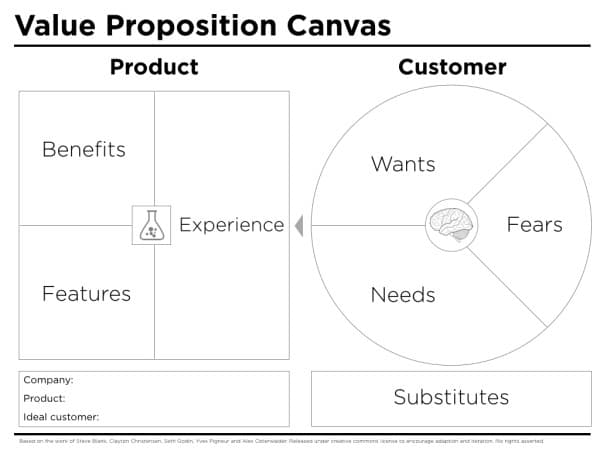
One classic method is the Value Proposition Canvas proposed by Peter Thomson. But I'd like to show you a simpler method.
The value bar
Imagine your service costs a hundred bucks. If you sell wedding photography, that hundred bucks buys your portfolio website, the emails you send the client, the way you carry yourself at the wedding, and finally, the photos you deliver — and, you're probably already aware of it — the emotions those photos trigger.
Or maybe you're a dietitian? People come to you to lose weight before some important event in their life (let's stick with weddings, since we're on the subject). Before they become clients, they visit your website. Once they decide to sign up, you run an initial assessment, then consultations, you build a nutrition plan, and you check in on their progress by calling them.
Let the customer speak
“Dr. Magda won me over in our very first phone call — specifically, her enormous energy and warmth came through in her voice.”
Ewa
“Such a lovely doctor. She listened. She examined me. She explained everything thoroughly. She gave me nutrition guidance. Once home, I even found a few more important notes she'd sent to my e-mail, summarizing the visit.”
Marta
Both reviews above come from ZnanyLekarz, a Polish doctor-review platform, and are about Dr. Magdalena Superson. Read them and think about what makes up a big share of her value bar. The first review talks about “energy and great warmth in her voice.” The second opens with “lovely” and “she listened.” Those are the things customers notice — not just about this particular doctor, but about other dietitians too.
Market definition
Thinking about your product or service as a value bar gives you one more benefit: it's easier to figure out who actually needs it.
“Hey, want to pay a hundred bucks to look gorgeous in your wedding dress?” If you ask me, I'd say no. I have no wedding plans in the foreseeable future, and even if I did, a wedding dress is a bit outside my personal style. I'm not your market. But there are people who want exactly that. And finding them (and naming that group) is the first step toward defining your market in your value proposition.
“Hey, did your doctor refer you to physical therapy? I know you don't want to buy it, but you have to — it costs a hundred bucks”. The second customer segment you can target is people who have to do something. They have to pay their taxes, go on a business trip, register their kids for school… Find someone who has no other option, and… they're your customer.
“Hey, if you pay me a hundred bucks, you never have to worry about your driving test again — I guarantee you'll pass”. The third customer segment is people who are afraid of something. Offer to chase away their fear, and you won't be able to keep up with orders.
The “look great in a wedding dress” example combines wanting, needing, and fearing.
What does “the same thing” actually mean?
Kahneman's experiment surfaced one more thread. Students said they'd be willing to pay for the injection that gave them the memories of their dream vacation… without ever having to travel anywhere.
The takeaway? The memories of the trip make up the lion's share of the value bar. But there's a second takeaway: for the participants, a device that produces memories is “the same thing” as the actual trip.
Back to our dietitian (or personal trainer — let's widen the range of examples). Does your client want to pay for a workout or nutrition plan that will make her look stunning in her wedding dress? You might think so. But what happens if someone else offers her a pill that produces the exact same stunning look? The end result makes up the lion's share of your value bar. And to the client, the workouts and the pill are “the same thing”.
“The same thing” could also be a self-acceptance course that lets me walk down the aisle happy with my body, regardless of how I look. And of course, other dietitians offering a solution to the same problem are also “the same thing.” Which brings us to the final section.
Why you?
The task here is simple: prove that the “same thing” from the previous paragraph isn't actually the same thing.
A pill? Sure, but what about the rebound effect? A self-acceptance course? Wonderful, but the long-term health issue is still there. Other dietitians? Can they show certifications, track records?
Look at your own value bar and ask yourself, which elements should stay to set you apart from everyone else?
What proves your value proposition? You can use two shortcuts:
- Authority transfer. Reference something your prospect already knows. “Hi, I'm Paul Skah, and I help build strong brands. I've worked with names like Sony, HBO, and Orange.” Recognizable names, companies, certifications, awards — you can borrow credibility from any of them.
Read Piotr Bucki's “Job Experience” page and underline every institution whose name you recognize that Piotr name-drops.

- Numbers. Concrete, measurable metrics that you have and your competitors don't. Number of clients you've served, hours spent training people, percentage of satisfied customers, most locations in your city.
Visual elements of a value proposition
A value proposition needs to grab attention. Structurally, that's usually a big headline, a few sentences of intro copy, and a handful of bullet points backing up your claim. But there's one more thing.
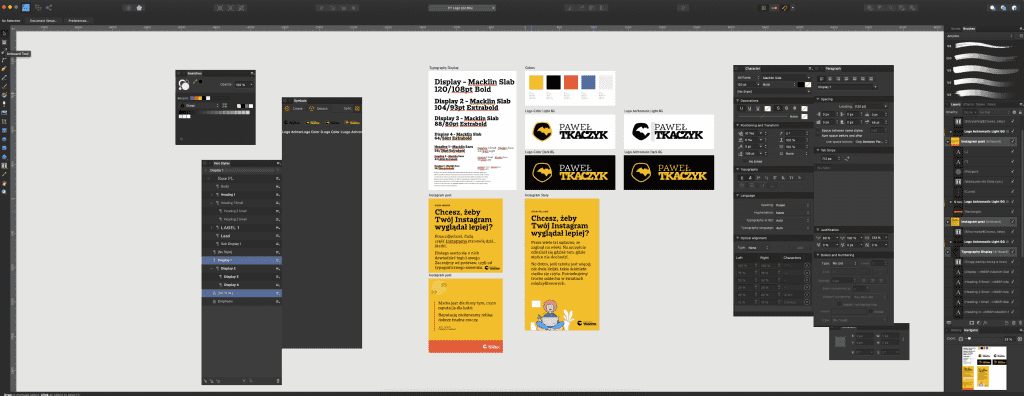
A value proposition has to be memorable — it needs to trigger associations. The best way to do that is through repetition of elements across different parts of your communication. And those elements don't have to be text — you also need recurring images, colors, and other cues that trigger associations with your value proposition. In branding, we call this a key visual.
Build templates (or have someone build them for you) that you can fill with your own content across different channels
Where should your value proposition live?
Put simply: it should be one of the first messages your audience encounters at every touchpoint with your brand.
- On your website, put it on the homepage, and definitely on the “about” page — and if it's short enough, make it part of your header.
- If you have a blog, your value proposition should be part of your bio under every article — people don't only land on your homepage.
- On Instagram, put it in your bio if it fits. If it doesn't — record a welcome Story and pin it to your highlights.
- On Facebook, its place is your cover image and your bio.
- On LinkedIn, you get a “short profile summary” — that's the perfect spot for your value proposition. You can also use a cover image there.
- YouTube has a channel trailer. Also remember to repeat your value proposition across your other videos (ideally near the start) — people won't necessarily browse your entire channel.
Good luck!

Newsletter
Want more essays like this one?
One useful idea at a time — on brands, choices, stories and AI. Written when there is something worth developing, not to fill a schedule.