
Blog
European Alternatives to US Software: A Practical Guide for Small Businesses
May 2025, The Hague. The chief prosecutor of the International Criminal Court loses access to his work email. Not because of an outage, and not because of a forgotten password. A few months earlier, the Trump administration had sanctioned him — and his mailbox sat on Microsoft's servers, an American company that has to comply with American sanctions.
Reports spread that Microsoft had blocked the account (the company denies it, and the story remains murky to this day), but the upshot was that the prosecutor moved to the Swiss Proton Mail. The Dutch government launched a review of its dependence on American technology. And by late 2025, the Court itself announced it was dropping Microsoft's suite in favor of the European OpenDesk.
If this can happen to a prosecutor at a tribunal in The Hague, it can happen to your business too.
I'm not writing this to scare you. I'm writing it because more and more entrepreneurs and marketers are asking themselves: are there European alternatives to the tools I use every day? The answer is yes, and there are more of them than you'd think. In this article, we'll walk through a concrete business scenario and see what can be replaced, what it costs, and where American solutions are still unbeatable.
Why bother with European alternatives?
Two reasons. The first is purely business. The second, let's call it, is civilizational.
- The business reason: concentration risk. If your email, calendar, documents, files, and ads all sit with one provider, you don't have a provider — you have a single point of failure (single point of failure). A blocked Google account — because of an algorithm glitch, a billing dispute, or a political decision made an ocean away — can cut a business off from its correspondence, invoices, and customer history in a single day. On top of that comes vendor lock-in (vendor lock-in): the deeper you sit inside an ecosystem, the easier it is for the provider to raise prices. And you're paying in dollars, or with the dollar exchange rate lurking in the background.
- The civilizational reason: digital sovereignty. The American CLOUD Act lets US authorities demand data from American tech companies regardless of where the servers physically sit. A Microsoft server in Amsterdam is subject to US law exactly like one in Virginia. For most businesses, this is a theoretical risk. But the story of prosecutor Khan shows that theory can knock on your door.
How big is this dependence? According to Synergy Research Group (2025), the three American giants — Amazon, Microsoft, and Google — control about 70% of the European cloud services market. All European providers combined: about 15%. On their own turf.
And now an important caveat before we go further: digital sovereignty isn't a switch you flip to “on.” It's a slider. You can move it by 20%, 50%, or 80% — and every one of those settings beats full dependence. This article will show you where you can move that slider cheaply and painlessly, and where you'll pay for it in convenience.
Case study: the solo entrepreneur
To avoid talking in the abstract, let's take a concrete case. You're starting a one-person marketing consultancy. You advise clients, run their campaigns, and create their social media content. Your list of needs looks like this:
- email on your own domain, plus a calendar,
- documents, spreadsheets, and presentations (ideally with client collaboration),
- cloud storage and file sharing,
- online meetings,
- creating social media content: graphics and scheduling posts,
- website analytics,
- invoicing,
- an AI assistant for everyday work.
The standard answer to this list is: Google Workspace or Microsoft 365 plus a handful of Silicon Valley tools. Let's see what European alternatives look like for each item — in two variants. In the first, you stay on Windows or macOS and only swap the services. In the second, you go a step further and swap the operating system too.
Path one: staying on Windows or macOS
This is the option for most people. The operating system stays American, but the whole services layer — meaning where your data actually lives — moves to Europe. The good news: in 2026, you can do this without heroics.
Mail, calendar, documents, and storage — an alternative to Google Workspace
There are three sensible directions here, depending on your temperament.
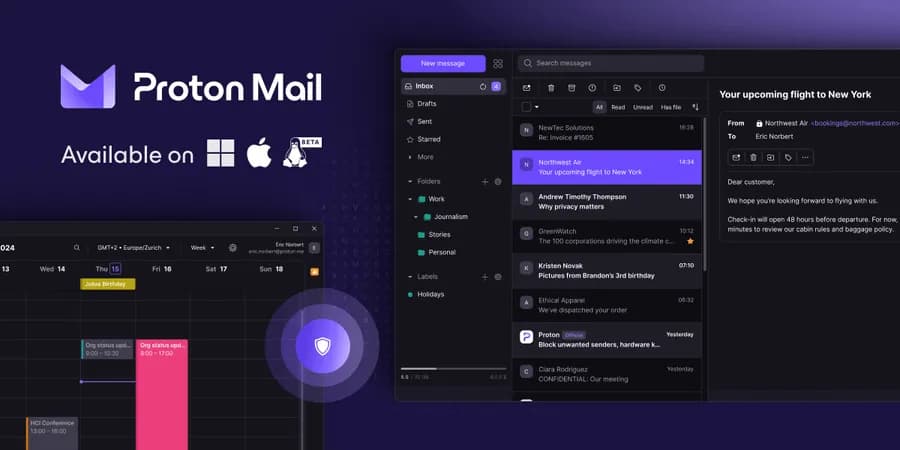
- Infomaniak kSuite (Switzerland) — the closest match to the “all-in-one” approach. Email on your own domain, a calendar, kDrive storage synced to your computer and phone, browser-based document editing (built on OnlyOffice technology), kMeet video calls, and kChat team chat. Servers exclusively in Switzerland, a company that's been around for more than 30 years and prides itself on powering its data centers with renewable energy. Pricing starts at 5.75 francs (about €6) per user per month — comparable to or cheaper than Google Workspace. From a one-person business's perspective, this is the simplest switch: one bill, one dashboard, everything talks to everything else.
- Proton (Switzerland) — the direction for people who care more about privacy than about collaboration convenience. Proton Mail, Calendar, Drive, and the Proton Pass password manager, everything encrypted end-to-end. This is where prosecutor Khan moved. Proton is investing heavily — they recently added a Meet equivalent for video calls. Everything is polished and well integrated. And having a password manager bundled in is genuinely useful.
- Nextcloud (Germany) — the direction for tinkerers and companies that want to keep everything in-house. Open-source software: storage, documents (Nextcloud Office running on the Collabora engine, i.e. LibreOffice technology), a calendar, and calls. You can self-host it or buy it from a European hosting provider. It's also the foundation of the OpenDesk mentioned earlier — the suite the German public sector is building specifically to make government offices independent of Microsoft. If a tribunal in The Hague can run on it, your business can too.
And if you need a classic desktop office suite, no cloud required? LibreOffice, developed by the Berlin-based Document Foundation, opens and saves Word and Excel files. For free.
There's one more name on the horizon worth remembering: Euro-Office. In spring 2026, a consortium of European companies — Nextcloud, IONOS, Proton, Tuta, XWiki, and a few others — announced a joint, open-source document-editing engine built on the ONLYOFFICE codebase. Why? ONLYOFFICE's developers, despite the company being registered in Latvia, work mainly out of Russia — and a “sovereign” office suite with a Russian backend sounds like a grim joke. To be fair, though: as of today, Euro-Office is an early-stage project. The code is being built in the open, but there's no official release yet, no mobile apps, no commercial support — and a licensing dispute with ONLYOFFICE is playing out in the background. For now, it's a promise, not a product. Though it's a promise made by companies that serve millions of European users, so it's worth keeping an eye on.
Search engines — what to replace Google with
Here I'll be honest with you, because this is the area where European alternatives have the hardest time. A search engine isn't an app — it's an index, a copy of the internet that has to be constantly refreshed. Building your own index costs billions, which is why most “alternative” search engines run on Bing's index (yes, Microsoft's) and add their own privacy layer on top.
Here's what you have to choose from:
- Qwant (France) — doesn't profile users, blends the Bing index with its own. A solid default choice.
- Ecosia (Germany) — results from Bing or Google, but 80% of surplus revenue goes to conservation projects, mostly tree planting. A search engine as an environmental gesture.
- Mojeek (United Kingdom) — a rarity: a fully independent index. Results can be weaker than Google's, but it's the most independent option on the continent.
An interesting development that bodes well: Qwant and Ecosia have joined forces to build a shared European search index, to break free of American search engines. The sovereignty slider is moving slowly, but in the right direction.
Practical tip: switching search engines is the cheapest first step in this whole operation. Thirty seconds in your browser settings, zero cost.
Browsers — what to replace Chrome and Edge with
Switching browsers is one of the fastest steps you can take. It's not an email migration, an archive transfer, or a weekend spent exporting files. You download the app, sign in to your services, set a new search engine, and spend a week checking whether anything hurts. If nothing does, you've moved the sovereignty slider at zero cost and without touching the rest of your business.
It's worth distinguishing two things here: a European company and a European browser engine. There's practically no such thing as the latter. Most alternatives are built on Chromium (Chrome's open-source engine) or Gecko, Firefox's engine. That's still a technological dependency, but a smaller one than using a browser, search engine, mail, storage, and ads all from a single provider.
The most practical options:
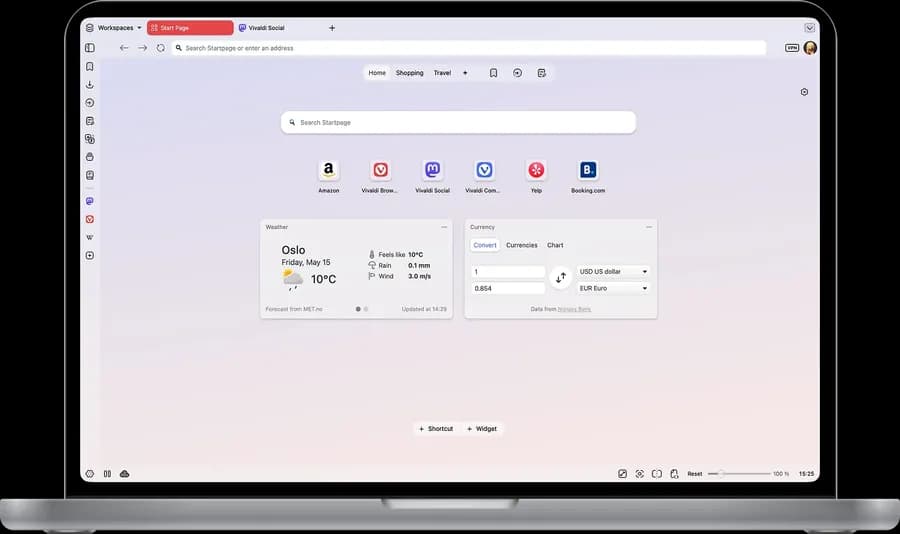
- Vivaldi (Norway/Iceland) — the best choice for “normal, everyday work.” It's a browser built by an independent company out of Oslo and Reykjavik, with no outside investors and no user profiling. It runs on Chromium, so it supports Chrome extensions, but adds its own tools on top: ad and tracker blocking, vertical tabs, workspaces, notes, a mail client, a calendar, an RSS reader, and Proton VPN integration. If you currently live in Chrome, Vivaldi is the least painful switch.
- Mullvad Browser (Sweden + Tor Project) — a choice for privacy, not necessarily for a full day of work. Sweden's Mullvad built it together with the Tor Project team. It's free, open-source, doesn't keep cookies between sessions by default, limits fingerprinting, and collects no telemetry. Great for research, sensitive queries, testing ads, and checking pages with a “clean” browser. For logging into all your services every day, it can be less convenient, precisely because privacy is its main goal.
- Waterfox (United Kingdom) — a privacy-focused Firefox fork for people who prefer the Gecko engine over Chromium. It has zero telemetry, prioritizes user control, and gives you plenty of settings without needing extra extensions. A good option if you'd rather not add to Chromium's dominance but still need a normal desktop browser.
- LibreWolf (open-source community) — the sharpest option on this list. It's Firefox after a privacy overhaul: no telemetry, uBlock Origin built in, tougher security and privacy settings. The downside: some conveniences are deliberately switched off, and updates depend on how you installed it. I'd recommend it to technical users rather than to an entire marketing team.
And what about Opera? It has Norwegian roots, but today it isn't a clean European answer to the digital-sovereignty problem. If you're looking for a browser “because it's convenient,” you can consider it. If you're looking for a browser “because Europe and lower geopolitical risk,” you're better off starting with Vivaldi or Mullvad Browser.
Online meetings
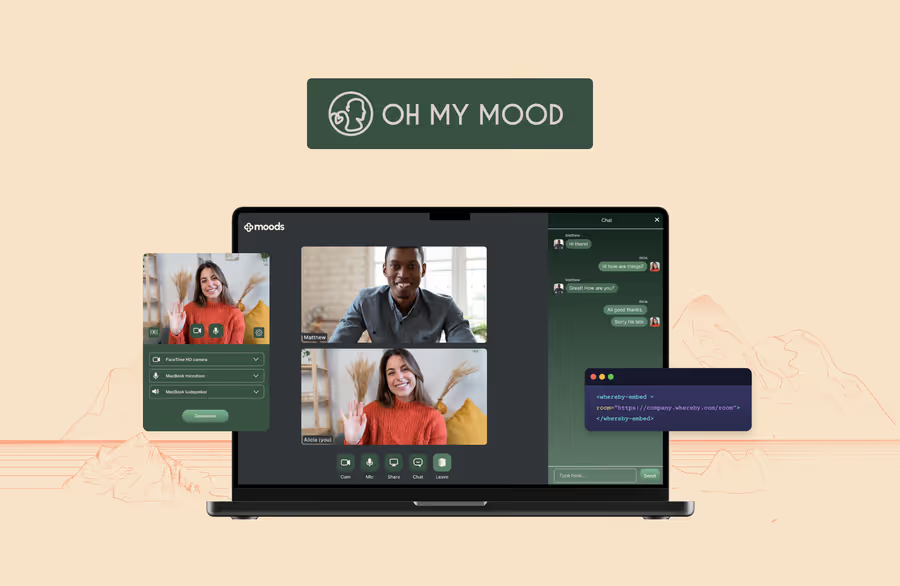
Whereby (Norway) runs in the browser, no installation required — you send the client a link and that's it. Infomaniak's kMeet is free and also doesn't require an account. Then there's Proton's Meet. All of these options comfortably replace Zoom in a solo entrepreneur's day-to-day work.
Messaging apps — what to replace WhatsApp, Slack, and Teams with
The situation here resembles social media. European alternatives exist, and some of them are very good. But choosing a messaging app for business isn't decided only by security, country of origin, and encryption. It also comes down to a simple question: are the people you need to talk to actually there?
Inside your own company, you have full control. You can decide the team talks on a European tool, end of story. That control disappears with clients. If a client has been sending briefs over WhatsApp, Messenger, or LinkedIn for five years, you can suggest a safer channel — but you can't pretend that switching messaging apps is purely a technology decision. It's a habit change on both sides.
The most interesting European options:
- Element (United Kingdom / Germany / France) — a messaging app built on the open Matrix standard. It offers chats, groups, voice and video calls, end-to-end encryption, and the option to self-host. It's a good choice for companies and organizations that want communication under their own control, not just “another SaaS account.” Matrix also has the advantage of being federated — it works more like email than Slack's walled garden.
- Threema (Switzerland) — the simplest WhatsApp alternative if privacy is your priority. It doesn't require a phone number or email address, has end-to-end encryption, a business version (Threema Work), and a self-hosting option. The downside is obvious: you pay for privacy in money and in a smaller contact network. Not every client will want to install a paid messaging app just to send you “approved.”
- Wire (Switzerland) — a team messaging app and an alternative to Slack or Teams, aimed more at organizations than private chat. It has messaging, calls, conferencing, file sharing, end-to-end encryption, and deployments for government and companies that need control over their data.
- Olvid (France) — a very strong option for sensitive conversations. It doesn't require a phone number, email, or access to your contacts, and communication is end-to-end encrypted. This is a tool for situations where security matters more than convenience and network effects. Not for chatting with every client, but absolutely for discussing confidential matters.
- kChat (Switzerland) — the messaging app bundled into Infomaniak's suite. I wouldn't try to replace WhatsApp with it in the consumer market, but if you're already getting kSuite, you get a simple company chat without adding another vendor.
Practical tip: don't start a war with your clients. Start with your own team and collaborators. Pick one European messaging app for company business, and treat WhatsApp, Messenger, and LinkedIn as market-contact channels — the same way you treat Facebook or Instagram. They're not perfect, but that's where the people are. Digital sovereignty isn't about taking offense at reality — it's about consciously choosing where you can actually move the slider.
Social media content
I have two surprises for you here.
The first: Photopea. Photoshop in the browser, supports PSD files, and costs a fraction of Adobe's price (the free, ad-supported version is more than enough for social media graphics). It's built by one person — Ivan Kutskir from Prague. One person from Czechia versus a corporation from San Jose, and that one person wins on “capability per dollar.”
The second surprise: Canva, which you probably think of as the obvious choice, isn't American at all. It's an Australian company. Not Europe, sure, but not Silicon Valley either — and in the geopolitical risk calculation, that's still a difference.
For scheduling posts: Kontentino from Slovakia — a content calendar, client approvals, publishing across every platform. A tool built by an agency for agencies, so it understands your workflow. For designing mockups and vector graphics: Penpot from Spain, an open-source alternative to Figma. A reminder: Adobe tried to buy Figma, and the deal only fell apart under regulatory pressure. The simple fact that the tool holding your projects could change owners overnight says everything about concentration risk.
Newsletters and email marketing
Here's more good news, this time from Poland: GetResponse out of Gdańsk is one of the oldest email marketing platforms in the world — newsletters, automations, funnels, and landing pages, all under one roof. Next to it, the Lithuanian MailerLite, a favorite among small businesses for its simplicity and fair pricing, and the French Brevo (formerly Sendinblue), if you want to send SMS messages in addition to email. Mailchimp, where many businesses got their start, can be crossed off without regret — in this category, European alternatives don't fall short of the American ones in any way, and they're often cheaper.
Website analytics
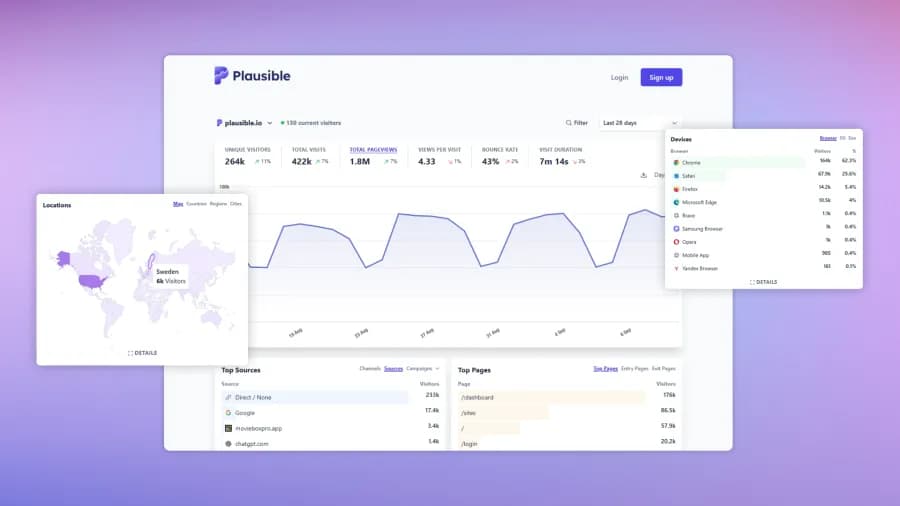
This is a category where Poland plays in the top league. Piwik PRO out of Wrocław is a full-fledged, enterprise-grade analytics platform — with a free plan that's more than enough for a one-person business. You can keep your data on servers in the EU, and the reports will look familiar to anyone who's worked with Google Analytics. A lighter alternative: the Estonian Plausible — one script, one clear dashboard, zero cookies, which makes life with GDPR much simpler.
And notice the paradox: Google Analytics is “free” because you pay with your users' data. Plausible costs a few euros a month because that's the only currency it needs. It's a good illustration of this whole switch: European tools more often ask you to pay with money, not with privacy.
Invoicing and hosting
Invoicing is actually a category where you don't have to “replace” anything — Polish tools like Fakturownia or inFakt are better suited to Polish tax regulations (KSeF, JPK) than anything from across the ocean. Website hosting? The French OVHcloud or the German Hetzner have been hosting half the European internet for years, at prices the American giants can't touch. Online payments for clients? The Dutch Mollie and Adyen handle half of European e-commerce. And in Poland, we also have InPost Pay.
Small things that make a difference
Three quick additions before we get to AI. Password manager: the Lithuanian NordPass (from the makers of NordVPN) or Proton Pass bundled with the rest of Proton's services — both options replace LastPass or 1Password without any pain. And a VPN, if you use one: NordVPN is Lithuanian, Proton VPN is Swiss. So in this particular category, you're probably already European — you just didn't know it.
AI assistant
Mistral out of Paris is the most serious European player in generative AI. Their assistant — known as Le Chat until recently, renamed Vibe in May 2026 — costs €14.99 a month for the Pro version (cheaper than ChatGPT Plus), has a document-working mode, and integrates with business tools. For a marketer's everyday tasks — posts, summaries, brainstorming, research — it's more than enough.
And if you generate graphics for campaigns, remember the name Black Forest Labs — a German lab whose FLUX models rank among the world's best for image generation. Yes, in this particular race, Europe can run neck and neck with Silicon Valley.
Is Mistral's assistant on the same level as the best American models? No. And we'll talk about that honestly in a moment.
Path two: a European operating system
Now for the option for the bold. If we've already swapped the services, why not swap the foundation too? Windows and macOS are the last layer of American dependence sitting on your desk.
In practice, the answer is: Linux, ideally in a European distribution. And before you roll your eyes — Linux in 2026 isn't a black screen with a blinking cursor. These are mature systems with a graphical desktop, an app store, and automatic updates that won't restart your computer in the middle of a presentation.
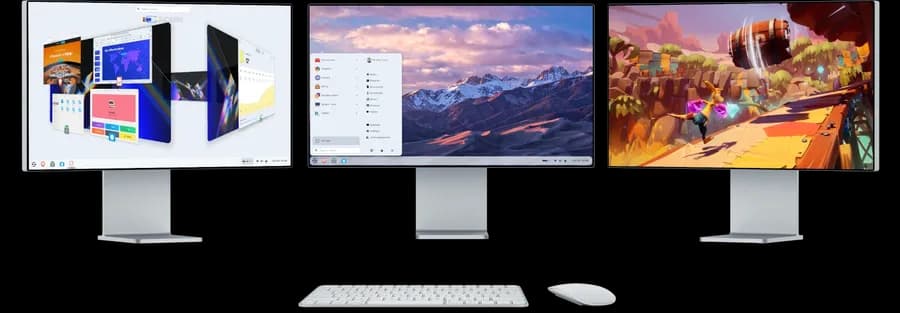
Three distributions worth a look:
- Zorin OS (Ireland) — built by the Zorin brothers from Dublin specifically for people fleeing Windows. The desktop looks and behaves like Windows, so the learning curve is minimal. This is where I'd start.
- SUSE / openSUSE (Germany) — German, enterprise-grade solidity, with paid support for businesses that need it.
- Ubuntu (United Kingdom) — the world's most popular Linux, developed by Canonical out of London. The biggest community, meaning it's the easiest place to find a solution to any problem.
Practical tip: you can run any of these systems from a USB stick, without installing anything and without touching Windows. You flash the system image onto the stick (with a tool like balenaEtcher), restart your computer, click around the desktop for an hour, and only then decide. Testing a European alternative to Windows costs you exactly as much as one USB stick.
Now, honestly: what stops working. Desktop Microsoft Office (the browser versions still work), Adobe Creative Cloud, some specialized industry software, and most games with anti-cheat systems. If your workday runs on InDesign and Premiere, stay on path one.
But here's something interesting: if you've already switched over on path one, most of your work already happens in the browser. kSuite, Photopea, Kontentino, Piwik PRO, Vibe — they all run in Firefox on Linux exactly the same way they do on Windows. Switching your services to European ones has, almost as a side effect, prepared you for switching the operating system too. The slider moves more easily than you'd expect.
Your phone? Here, the option is the French Murena with its /e/OS system — Android stripped of Google services, with its own cloud. It runs on ordinary phones (including the Fairphone), though at a cost to convenience: some banking apps can be temperamental. This is advanced-level stuff, but it exists. Though quite honestly, I wouldn't bother with it myself.
What you can't replace (yet)
I promised honesty, so it's time for a cold shower. Three areas where the sovereignty slider hits a hard wall.
- The platforms where your clients are. You can swap your post-scheduling tool for a Slovak one. But the posts will still go out to Facebook, Instagram, and LinkedIn, and you'll still buy ads through Meta Ads and Google Ads — because that's where your audience is. European social networks (like Mastodon or BeReal) exist, but for a marketer, audience size is the ultimate argument. The same goes for messaging apps: internally you can move your team to Element, Threema, or Wire, but a client may still want to message you on WhatsApp. There's no sensible alternative to a network effect, and there won't be one anytime soon.
- The frontier of AI models. Mistral is good, and good enough for most tasks. But the best language models — the ones you can write strategy with and that actually catch nuance — are built by OpenAI, Anthropic, and Google. All three American. If AI is at the heart of your work, dropping American models entirely means a real drop in quality today. A small consolation: ElevenLabs, the world leader in voice synthesis, was founded by two Poles — though formally it's an American-British company. We've got the talent; we're still building the market cap.
- The mobile duopoly. Your phone runs on Apple's or Google's operating system. Murena is an interesting experiment, but app stores, mobile payments, and push notifications are still infrastructure controlled by two companies from California. For now, that's something you live with.
The conclusion? A hundred percent independence is a fiction today — and that's fine. The goal isn't ideological purity, it's risk management. A business with mail in Switzerland, files in Germany, analytics out of Wrocław, and ads on Facebook is incomparably more resilient than one that keeps everything with a single overseas provider.
How to tackle it: a four-step migration plan
The worst thing you can do is a revolution — everything at once, in a single weekend. The best approach: diversify piece by piece, from the cheapest moves to the most expensive.
- Step 1: search engine and browser (cost: zero, time: 5 minutes). Set Qwant or Ecosia as your default search engine. Try Vivaldi as your main browser, and Mullvad Browser for research and more sensitive queries. You've got a safety net here: if a search result lets you down, you can always fall back to Google for that one tricky query. In my experience, that need comes up less often than you'd fear.
- Step 2: mail on your own domain (cost: ~€6/month, time: one evening). This is the single most important strategic move on this whole list. An address on your own domain means you can change email providers later without telling anyone — Infomaniak today, someone else in three years, and your clients won't even notice. Your own domain is your portability insurance: you buy it once, and after that, no provider ever has you by the throat.
- Step 3: files and documents (time: a weekend). Move your storage to kDrive, Proton Drive, or Nextcloud. Start with new projects — you can migrate the old archive slowly, or not at all. While you're at it, tidy up; treat it like a move, the kind where you finally throw out that box of “someday” cables.
- Step 4: analytics, content planning, AI (time: a month of testing). Run Piwik PRO or Plausible alongside Google Analytics and compare the numbers for a few weeks. Try Kontentino on a single client. Give Vibe a week of your everyday work and see where it holds up and where it doesn't.
After four steps, your sovereignty slider sits somewhere around 70% — and you can be sure that no single entity, corporation, or government can switch your business off with one move.
Wrapping up
Prosecutor Khan's story sounds like a “this doesn't apply to me” anecdote. And you're probably right — that exact scenario won't touch you. But the mechanism is universal: whoever controls your infrastructure controls your business. For twenty years, we handed over that control in exchange for convenience and the promise of “free.” Today, European alternatives are mature enough that, for similar convenience and similar (sometimes lower) money, you can take back a good chunk of that control.
Start with five minutes and a search engine. Then your own domain and mail. The slider will take care of the rest on its own.
And if you want to check what else can be replaced — from VPNs to CRM systems — check out https://euroalternative.eu/pl — a directory with a handy search feature, where you'll find even more obscure tools.

Newsletter
Want more essays like this one?
One useful idea at a time — on brands, choices, stories and AI. Written when there is something worth developing, not to fill a schedule.