
Blog
Marketing Trends 2026: Where Marketing Is Actually Heading
I'm genuinely excited about this article. Why? Because for the past few years, marketing hasn't seen anything you could really call a revolution. Trends were mostly extensions of things that had been building for a while. Not this time. In 2026, we're in for several marketing revolutions.
At the same time, there's a catch I want to flag right away. The revolution marketing is going through has strong technological foundations. That means some of it simply can't be done without a decent grasp of technology. I'll try to offer advice for both bigger companies (more tech-savvy) and smaller ones. But don't get discouraged if you don't understand everything, or can't do everything. Nobody has this 100% figured out.
While 2024 in marketing was still about grabbing users’ attention, and 2025 was the year AI went mainstream, 2026 will be the year of usefulness in the right interface. This shift runs much deeper than another platform to show up on or another video format to publish. What’s changing is the very architecture of the internet as we know it. And with it, the rules of the game.
Three forces driving these trends:
- time spent online is increasingly time spent inside a single app (TikTok, Instagram, LinkedIn, Amazon, ChatGPT);
- inside these apps, user attention is steered by algorithms that don’t build loyalty — they optimize for momentary relevance;
- trust and loyalty are becoming a commodity that’s luxurious, certified, and… expensive.
Below you’ll find the key areas that will determine marketing effectiveness in 2026. Plus a few things that are just emerging and worth keeping an eye on.
Technology: the internet and AI
For years, we’ve been trained to design sales funnels: ad → landing page → checkout → email. In 2026, that entire funnel will close inside a single app. Meta calls this in-thread experience (they talked about it at the Meta Marketing Summit, so this isn’t some far-off vision — it’s already happening at scale).
For Meta, that single point of contact is meant to be WhatsApp. There, a user sees an ad, clicks it, lands in a conversation thread, gets a personalized offer, and can complete the purchase with one tap. All without leaving the app. The model here is the so-called everything apps popular in Asian markets. I wrote about this trend back in 2025, and today we have social proof that it works outside Asia too.
What can you do right now?
- Look at the platforms’ native tools — Meta has WhatsApp Business and Click to Chat ads. TikTok has TikTok Seller.
- See which of your tools integrate with these platforms. Shopify is a great example here, offering a native interface for selling through TikTok.
Pillar content in social media
According to a Forbes/Adobe report, 25% of users already start their search on social media (Instagram, TikTok, Pinterest) instead of Google. That means you need to take some SEO strategies and bring them over to social. One of those strategies is pillar content — cornerstone content. In short: content that answers the questions users ask most often. If you get it right — comprehensive, genuinely helpful — you earn traffic and attention.
Sephora nails this — they shoot short videos answering questions like “how to choose a retinol” or “skincare routine order.” As a result, their content dominates inside social platforms and forms a solid base for in-thread experience. Notice that you can’t build a funnel inside a platform if you don’t have the content that funnel rests on.
What can you do?
- Draft a list of the basic questions about your industry, your buyer persona, and your product — in that order.
- Create comprehensive, genuinely helpful videos to fill your platforms with.
- Build sales funnels around tools like ManyChat or Spur, which let users move smoothly between your content and the checkout process.
Agent-to-Agent Marketing (B2A)
For Google or Microsoft, that single point of contact will be AI agents and assistants (I’m still fighting a losing battle to stop calling them “it” instead of “who” — old copywriter habits die hard). We’re already seeing more users search for products and information this way. So what can you do?
- Invest in GEO (Generative Engine Optimization, i.e. optimizing for AI text-generation tools). Product and service descriptions on your site should be plain and free of metaphors — so LLMs (Large Language Models) can understand them without a hitch.
- The advanced move is building dedicated pages with descriptions written for LLMs. That way you can route “human” traffic to one page and bots to another. Cloudflare offers a service like this, or you can handle it yourself with
robots.txtandllms.txtfiles. - Think of your website as the “single source of truth” about your product or service — not necessarily as your conversion point.
- Invest in tools that monitor your visibility in LLMs, like the Polish-made Chatbeat.
Custom GPT as a marketing channel
What is a Custom GPT? It’s a pre-configured ChatGPT loaded with knowledge that lets it perform a specific task better. Want an example?
At the I ❤️ Marketing conference, I talked about finding your unfair competitive advantage. I showed a framework called F.O.C.U.S. that helps you define one. I also gave attendees a Custom GPT that helps them find that unfair advantage for their own business.
Focus Find — click it and ChatGPT opens, asks you a handful of questions (10, to be exact), and generates a summary. Oh, and it’ll also mention it’s sponsored by Yggdrasil, my hub for entrepreneurs.
If you have knowledge that’s useful to your customers and want to turn it into a brand touchpoint, you could shoot a short-form video. But you could also learn a bit of prompting and hand customers a useful Custom GPT that says exactly what it should say and recommends exactly what it should recommend. The possibilities here are almost endless.
Want to go one step further?
MCP as a marketing channel
What’s this odd abbreviation? Let’s start with the basics. MCP stands for Model Context Protocol — a protocol (a way of exchanging data) that lets language models like ChatGPT, Google Gemini, or Claude receive real-time information you care about. This protocol runs on a server, and that server’s job isn’t just to hand over data — it also processes it when needed.
The simplest example? You ask a language model how much revenue product X generated in your online store. The model contacts an MCP server from an invoicing tool or Shopify, the server processes the data, sends it back to your model and… you get an answer. If your brand normally requires users to log in and dig through data themselves, exposing an MCP server means customers using agents or language models will reach your data anyway — and will prefer you for it. One example already doing this is inFakt.
ChatGPT has an Apps tab. You’ll find things like Spotify, Booking, or TripAdvisor there. These are all MCP servers that let you connect agents, helping build you a personalized playlist, find you a hotel, or recommend things to do on a trip.
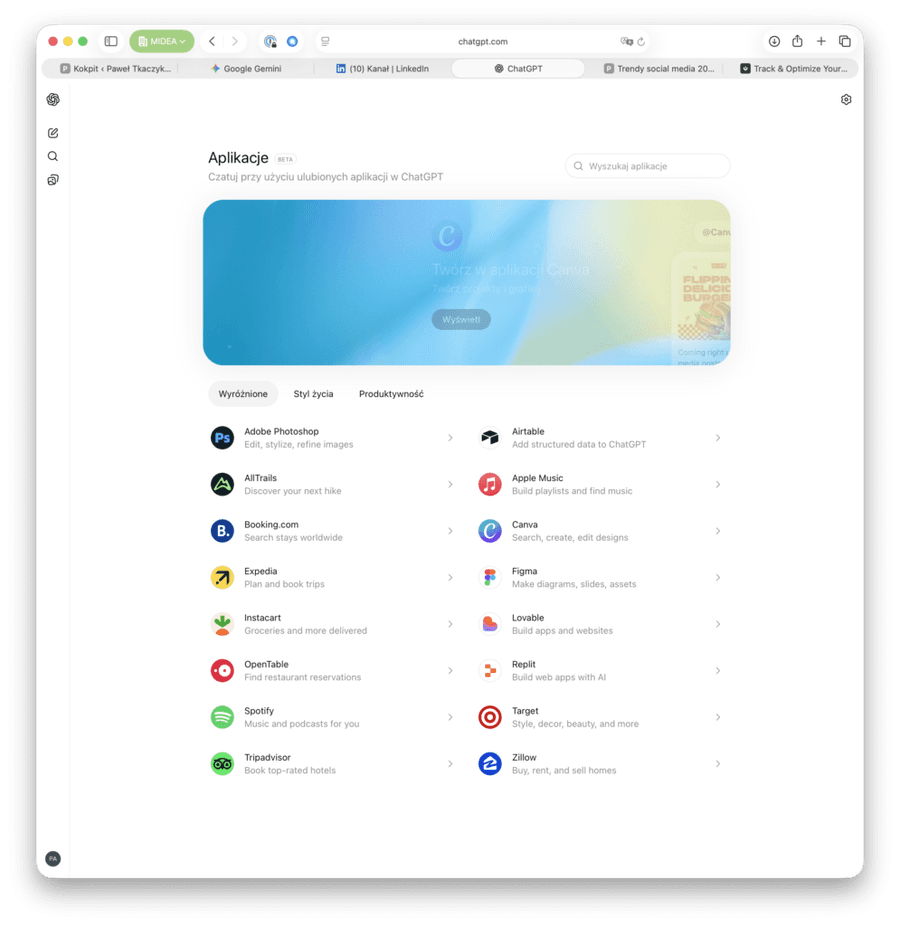
If you have the technical know-how and capacity (and a service that fits), think of an MCP server as a marketing communication channel.
MCP UI — generating interfaces
OK, here’s another one for the advanced crowd. You already know what an MCP server is. You know it can return data to your assistant. But not every task should get its answer as plain text. What if we returned, say, product cards with photos, prices, and a “buy” button? Or charts, when you ask for data? That’s exactly what MCP UI is — an MCP server that returns… user interfaces.
Two examples we already have. The Shopify integration with Claude (Anthropic’s LLM). You ask it about products, you get back product cards. There will be more solutions like this. Google is going a step further. Disco (an experimental feature at the time of writing, not yet available to everyone) opens a new tab in your browser — a tab that’s a complete mini-app built to solve one specific problem. That could be a scientific question (how does entropy work?), a comparison of different e-bikes, or a simple memory-training game.
In 2026, we’ll see more AI generating interfaces on the fly. Ideally, that interface should reflect your brand’s identity — colors, logo. You could hand a customer an entire storefront, generated on the spot by AI.
People: trust and credibility
Alright, enough about AI as the main character. Let’s talk about the human factor in all of this.
A new era for influencers
At the end of 2025, the Cyberspace Administration of China introduced restrictions on influencers — if you talk about sensitive, socially important topics like health and medicine, finance, law, or education, you now have to prove you know what you’re talking about instead of just winging it. Social platforms in China are required to make influencers upload diplomas confirming their expertise. And influencers themselves are required to cite the sources behind the claims in their videos.
But the CAC regulations go beyond diplomas. Advertising content has to be clearly labeled, and so does AI-generated content. Flaunting wealth is also becoming off-limits — no more videos filmed in a rented Lambo or a luxury apartment.
China’s drastic move sparked a lot of positive reactions on our side of the globe. There’s no regulation like it here yet, but brands are noticing the applause. That’s why I expect a push toward influencer self-regulation. How do you prepare for it?
- Audit your influencers. Don’t look for people who just talk about health. Look for people who have earned the right to talk about it. That protects you from a public backlash.
- Certified influencers will get more expensive. If the trend picks up and the public really does start looking sideways at “uncertified” influencers, the certified ones will raise their rates. That’ll pay off in the long run — for the sake of your brand’s reputational safety.
- Employee advocacy. If external certified influencers get expensive, it’ll start paying off for brands to train and promote their own. In industries where certification becomes welcome — or maybe required — this will become a more attractive career path.
- Building your own brand as an influencer? Define your area of expertise and work at earning it. Jack of all trades, master of none.
“Black hat” and “white hat” deepfakes
The awareness that whatever’s on screen could be entirely AI-generated and have nothing to do with reality has gone mainstream. People are turning away from AI — not because AI exists, but because of a trust problem. We still want useful synthetic content, but we’re demanding it be clearly labeled.
IKEA Japan has a virtual assistant. Imma “lives” at IKEA, she’s a virtual influencer, she’s upfront about what she is, she builds relationships with fans, and people are fine with it. So: building a digital avatar with a consistent personality will be welcomed. Churning out AI slop (you know the term?) or running faceless, personality-free accounts will get punished. Maybe not by users directly, but by platform algorithms — because in the long run, platforms don’t want to be known as “a place full of AI slop and deepfakes.”
OpenAI signed a deal with Disney — thanks to it, content generated by Sora (their video-generation model) will feature licensed characters from Marvel movies and cartoons.
What can you do?
- A brand is built through consistency. If you’re going to generate AI content, make sure it has a distinctive character — visually, for instance. What’s the point of using AI if the result looks like it was shot on a phone?
- Work on your brand’s voice. Literally. Tools like ElevenLabs let you design custom voices. Don’t use the same stock narrator everyone else does.
- Design a whole world around your virtual avatar. Give it a personality, problems, companions.
Long-form content
User engagement with long educational and entertaining content beats mindless short-form clips. Internationally, we have great examples like Liquid Death or Red Bull’s documentary work. In Poland, the Zamoyski Museum and their series — now followed by a book. Is there a better recommendation for long-form content than that?
The key to social media is still a mix of education and entertainment. If your content is missing either one, someone else will overtake you.
What can you do:
- Use the earlier points — a distinctive visual style, a unique voice, or your brand’s world will serve you well even when you’re not generating content with AI.
Data straight from the source
Users want to protect their privacy. In the European Union, increasingly strict privacy regulations keep coming into force. At the same time, those same users say they’re happy to hand over their data in exchange for something tangible in return.
The trend is collecting user data not through cookies or anonymized stats from Meta, but straight from the source — the users themselves. L’Oréal does this well: it helps you pick the right cream through an interactive quiz where users don’t just share their gender and age, but even upload photos of their skin.
You can go a step further and design a more elaborate quiz system, even bringing in gamification. Tools like Thrive Quiz Builder or Heyflow will help you build an entire system you can connect to your CRM.
How to approach it:
- Decide what data you actually want from your audience. Don’t over-collect, but do gather what you need to sell.
- Find a problem you can solve for them right away. Promise the solution as the reward for completing the survey or quiz.
- Tailor your offer to the data you collect. There’s no point gathering data you never use for personalization.
Digital wellbeing
Customers are overstimulated, overloaded. Brands are noticing this trend and trying to ride it. A few examples:
- 37signals (the makers of Basecamp, the project-management tool, and Hey, their fresh take on email and calendars) have long argued that chasing real-time notifications or sitting through meetings that could’ve been an email leads nowhere. That’s exactly how they market their brand and products.
- IKEA (which already showed up earlier on this list, but they really do great marketing) promotes good sleep and balance in its ads, offering tips on putting your phone away in the kitchen or bedroom.
- LEGO, which openly states that its apps have clear time limits and none of the dark patterns — interface tricks that dishonestly manufacture engagement.
What can you do as a brand?
- Design user experiences with an end in mind, not infinity. One video a day. Go for a walk after watching it.
- Save your customer’s time. Treat it as a resource they’re spending on you. Be upfront about how you’re saving it — one-click newsletter unsubscribes, or automatically unsubscribing people who never open it.
- Reduce stimuli instead of maximizing them. Less is more. Move interactions to a channel like Telegram instead of Instagram.
Is that all the trends? No. We haven’t touched on brand-as-a-puzzle (I made a piece about that on Instagram), and we haven’t touched on last year’s trends still playing out (communities living outside social networks).
What about you? What trends do you see around you?

Newsletter
Want more essays like this one?
One useful idea at a time — on brands, choices, stories and AI. Written when there is something worth developing, not to fill a schedule.